Grok.com's detailed review of
Linux Air Combat from Apr2026
On 09Apr2026 we asked the following
question of the well-known, free "grok.com" Artificial Intelligence
service:
Please generate a detailed
review of "Linux Air Combat" (or "LAC"). Include details about hardware
requirements, the accuracy of its flight model, the effectiveness of
its user interface (clarity of menus, cockpit design, target tracking
and identification tools, and adaptability to flight control hardware
like joysticks, console game controllers, throttle quadrants, rudder
pedals, use of mouse and keyboard for flight controls etc.),
interplayer communication, and mission variety (tactical and strategic
elements etc.). Also summarize LAC's reputation among reviewers and
community members with regard to the "fun factor" of its online,
multi-player missions and the sufficiency of its graphics and sound
effects to inspire immersive fun. Comment on available, published
documentation and instructional video resources, etc. Finally, please
comment on what it is like to fly in the available online, multi-player
missions among the LAC community, with specific details about the
differences between flight during hours when there are abundant
Sentient players and hours when only "Replay Blokes" are available.
Grok
responded with THIS review:
Linux Air Combat
("LAC") is a
free, open-source, multiplayer WWII-era combat flight simulator
designed specifically for Linux. Developed and
maintained by Robert Bosen (with community contributions), it evolved
from
the older "GL-117" game into a full simulator emphasizing accessible,
high-performance air-to-air and air-to-ground combat. As of the latest
releases around version 9.83 - 9.92 (2025–2026), it features 54 flyable
WWII aircraft (plus one theoretical jet), sophisticated physics, and a
focus on online multiplayer. It runs natively on Linux desktops and
even low-end hardware like Raspberry Pi 4/5.
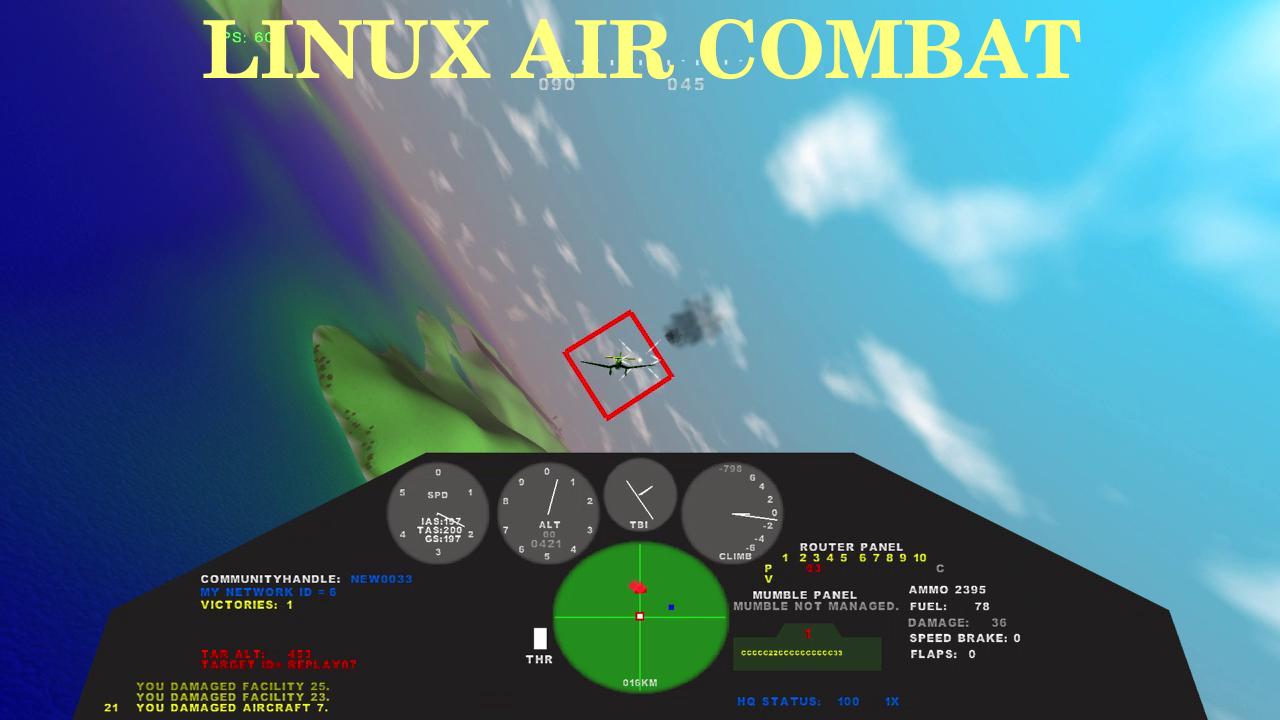
A view from LAC's cockpit during
online combat. The player, known as "NEW0833" is flying for the Blue
team (as indicated by blue text on the cockpit). His opponent,
framed in red, is directly in front of him, but he has been damaged and
is trailing smoke. The RADAR display highlights a small red icon with
an intense white center, indicating designation as the current mission
"Target". Cockpit instruments reveal additional information about the
selected Target, and that information is colored red in this instance,
to match the target's Red team affiliation. The player's location is
always at the exact center of the RADAR display (where the cross hairs
meet). The small red icon with the white center, representing the
Target, is near the center of the RADAR display due to his
proximity in the simulated battle. RADAR range is currently set at 16
kilometers, so objects at the edges of the display are about 16
kilometers away.
Hardware Requirements
LAC is exceptionally lightweight and optimized in efficient C/C++ for
maximum performance. It runs acceptably on virtually any desktop Linux
system capable of running modern Windows—essentially any PC built since
~2007. Minimum specs are very low: around 2 GB RAM and an older
Celeron/Pentium-class CPU suffice for smooth flight. It excels on
modest hardware, delivering high frame rates even at 1080p with simple
but effective 3D graphics. A Raspberry Pi 4B or 5 handles it
splendidly, making it one of the most accessible flight sims available.
No high-end GPU is required; it prioritizes speed over photorealism.
Precompiled AppImages bundle everything needed, so installation is
straightforward with no compilation or extra libraries required on most
distros.
Accuracy of the Flight Model
The flight model is sophisticated and historically inspired but tuned
for fun and accessibility rather than hardcore realism (e.g., unlike
DCS or IL-2 Sturmovik). It includes low-speed stalls, accelerated
stalls, compressibility effects, blackouts/redouts, torque rolls,
induced turbulence, low-speed control fade, realistic high-altitude
engine performance degradation, fuel consumption scaled to load
(including WEP/afterburner), damage effects, and performance penalties
for carrying bombs/rockets. Reviewers note that low- and
medium-altitude flight characteristics for the 54 WWII aircraft are
generally within 3–4% of the best available historic data, while
high-altitude behavior is less precise (around 10% variance) but still
enjoyable and tends to "penalize" overly aggressive maneuvers in a way
that feels balanced. Each plane has distinct strengths/weaknesses
(e.g., turn rates, climb, speed, armament). It's not a study-level sim,
but the blend of realism and playability creates engaging dogfights and
bomber intercepts without frustration.
Effectiveness of the User Interface
LAC's UI is old-school, functional, and highly effective once
learned—clear, uncluttered, and performance-oriented.
Cockpit design: A virtual
cockpit view with analog-style instruments
(speed, altitude, climb rate, etc.) overlaid on a simple 3D world. A
central radar scope with zoomable display range aids situational
awareness, and a "Network Router
Panel" displays real-time telemetry, peer data flow, and comms status.
A "Talking Cockpit" feature verbalizes critical info (e.g., target
location, altitude, warnings) via audio, reducing the need to glance
away. Target identification uses audio and visual cues, radar, and
simulated IFF
(Identify Friend or Foe). Red/blue text, icons, and framing highlight
and categorize other players and mission elements associated with the
"Red" and "Blue" teams, respectively.
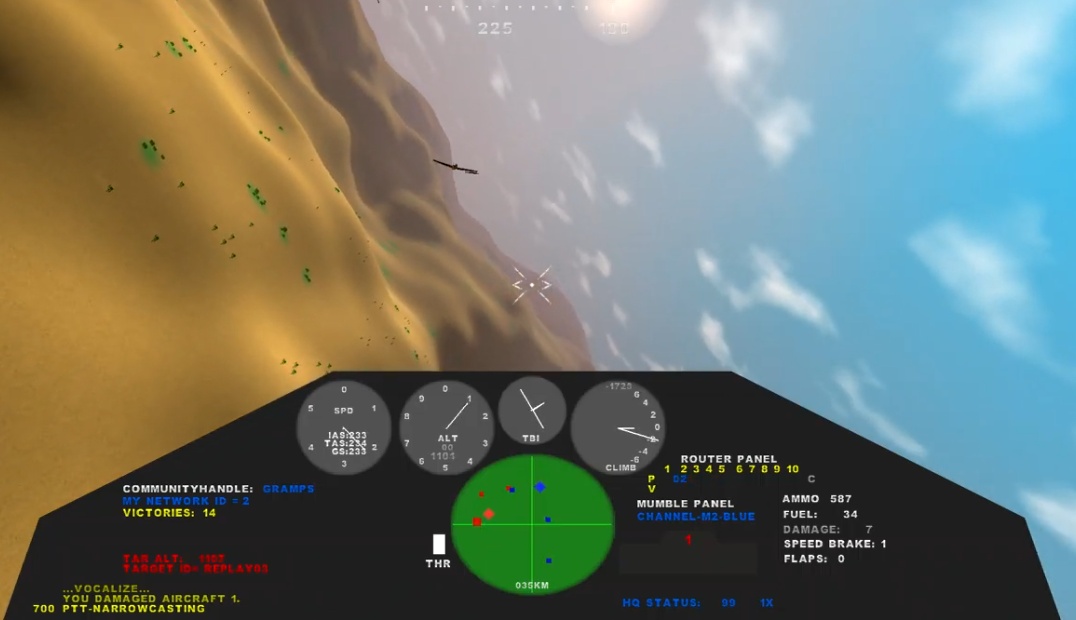
Another battle scene featuring LAC's
cockpit instruments while following another aircraft that is flying too
low for RADAR detection. This mission takes place in a desert terrain
and often features low-altitude skirmishes.
Menus and clarity: Straightforward and in-game accessible.
No complex
nested menus; aircraft selection feels like a "warbirds museum" with
per-plane stats and videos.
Configuration (controls, views) is quick
via keyboard or in-sim options.
Target tracking and identification tools: Built-in radar, visual
spotting aids, and automated radio/RADAR warnings for threats.
The
"Norden" bombsight emulation supports medium/high-altitude precision
bombing.
Adaptability to hardware: Excellent. Up to 45 flight/view
functions map
to any joystick axis/button or keyboard key. It supports modern
multi-axis joysticks (e.g., Logitech Extreme 3D Pro), throttle
quadrants, and rudder pedals via detected axes. Console-style USB game
controllers (cheap and popular) are fully supported with optimized
button mappings that replicate complex setups. Mouse works well for
elevators/ailerons/weapons (great for beginners or laptop play), and
keyboard/numpad handles throttle ( [ / ] keys), views, and more. No
issues reported with standard flight hardware; it's highly configurable.
Overall, the UI prioritizes clarity and immersion over
flashiness—perfect for its lightweight ethos.
Interplayer Communication
LAC shines here with deep integration. It uses a dedicated Mumble voice
server for world-class, low-latency team comms, including a rich
hierarchy of channels (team-specific, private sub-channels) and even
automated team-wide channel switching for tactics. A "Mumble Panel" in
the cockpit shows status. Text-based comms include a low-bandwidth
"Morse Code" radio option. Automated radio messages announce airfield
status, and 23 comms functions are mappable. Players see others'
CommunityHandles and mission status via an online player list. This
creates strong team coordination in multiplayer.
Mission Variety (Tactical and Strategic
Elements)
Missions blend tactical dogfighting with strategic depth:
Single-player/offline: Four
narrated tutorial missions, free flight, and offline combat. Users can
record "GunCamera films" for replay.
Multiplayer/online:
Head-to-head (2 players, no server needed), plus 10 distinct 10-player
Internet missions across varied terrains. Persistent "Strike" missions
in Realm 1 run continuously. Strategic elements include airfield
attacks/defenses (damageable guns/radar that repair over time, air-raid
sirens), bomber escorts/intercepts with auto-gunners and realistic
climb rates, rocket/bomb runs, and "Norden" bombing. Tactical dogfights
emphasize plane-vs-plane "dances." Real-time warnings and dynamic
battles (airfield threats trigger responses) add strategy. Additional
missions and user-loadable content (3D models, sounds) expand variety.
Reputation Among Reviewers and
Community: Fun Factor, Graphics, and Sound
LAC enjoys a strong reputation as the leading free/open-source
Linux-native air combat sim. SourceForge and community reviews (e.g.,
Reddit, Hacker News, Raspberry Pi forums) praise its "almost perfect
blend of realism and fun"—accessible yet engaging, with historic
simulation prioritized over arcade fluff. The "fun factor" in online
multiplayer is consistently highlighted: lively banter, immersive team
play via Mumble, and absorbing dogfights. Even solo play against
replays feels "really good" and "absorbing." Graphics are simple/retro
(reminiscent of early 2000s sims—blocky but smooth with high FPS and
customizable views), yet sufficient for immersion on any hardware.
Sound effects (customizable .wav files), engine noises, gunfire,
sirens, and the Talking Cockpit deliver solid audio feedback that
enhances the experience without demanding high-end hardware. It's not
photorealistic, but the performance and community make it "the most fun
I've had flight simming on Linux." The small but dedicated community
values its stability and ongoing support.
Available Documentation and
Instructional Resources
Documentation is extensive and high-quality for an open-source project.
The official site (askmisterwizard.com) and SourceForge host
comprehensive pages, forums, downloads, FAQs, feature lists, and
aircraft details with
stats and videos. YouTube is a standout: playlists cover
download/install,
visual user guides (cockpit/controls), flight training (basics to
advanced), controller setup, and solo vs. replay mission styles. Videos
include tutorials and multiplayer examples narrated with thoughtful,
absorbing radio banter recorded during online sessions. In-game help
and a
detailed log file further support users. It's well-documented and
beginner-friendly.
Flying in Online Multiplayer Missions
Among the LAC Community
LAC's online experience is its highlight, but the community is small,
so player density varies. "Sentient players" (real humans) create
dynamic, immersive sessions: abundant players mean chaotic, exciting
battles with voice banter, coordinated tactics (e.g., fighter sweeps,
bomber protection), and unpredictable maneuvers. Mumble turns it into a
social, team-oriented war—private channels for plans, real-time
strategy around airfields, and satisfying victories logged per player.
It's highly replayable and "liberating."
When only "Replay Blokes" are available (pre-recorded flights from past
real missions replayed by the server as AI opponents), it's still
remarkably fun and viable for solo or low-pop hours. Blokes fly
authentic paths, shoot back, and can be damaged/destroyed (though they
don't intelligently evade like humans). Persistent missions feel
alive—you join ongoing strikes, intercept bombers, or dogfight recorded
aces. It's educational for practice and less chaotic but still
engaging; real players can replace Blokes mid-mission for surprise.
Many reviews note it's "amazing" quality and draws players in even
alone. The server design ensures you never fly in total emptiness.
Here's a brief YouTube video with great insight about LAC's "Replay
Bloke" mission (and it's typical of the quality you can expect from any
of dozens and dozens of video clips about LAC):
In summary, LAC
delivers tremendous value as a lightweight, fun-focused WWII air combat
sim. Its low barriers, strong multiplayer tools, and clever solo
accommodations make it a gem for Linux users seeking accessible yet
deep aerial warfare. If you enjoy classic flight sims with a passionate
(if niche) community, it's highly recommended—download from SourceForge
or itch.io and join the fun.